Simulation of Multibody Systems
One of Ride Technologies‘ core competencies is modeling and simulation using Multibody Systems (MBS). To this end, we utilize state-of-the-art software to transform mechanisms into a mechanically idealized model. Multibody systems enable the precise calculation of kinematic and kinetic quantities – such as accelerations, forces, displacements, moments, and even component stress – at a very early project stage.
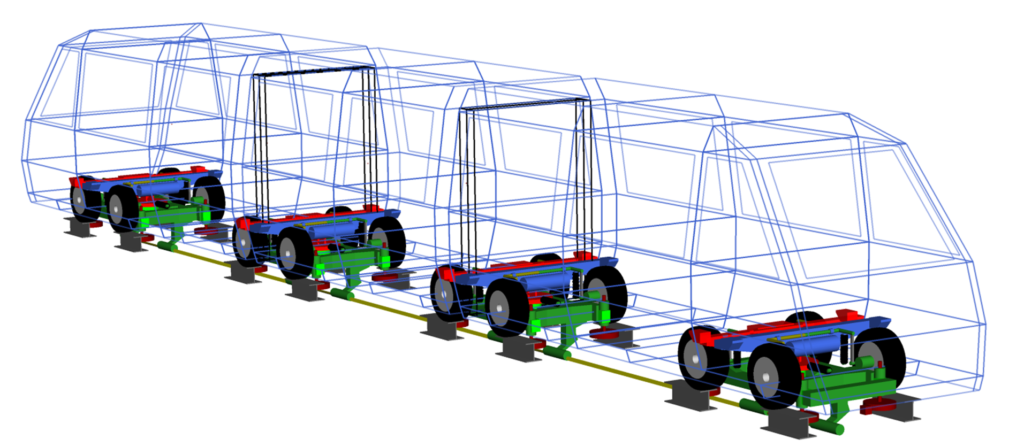
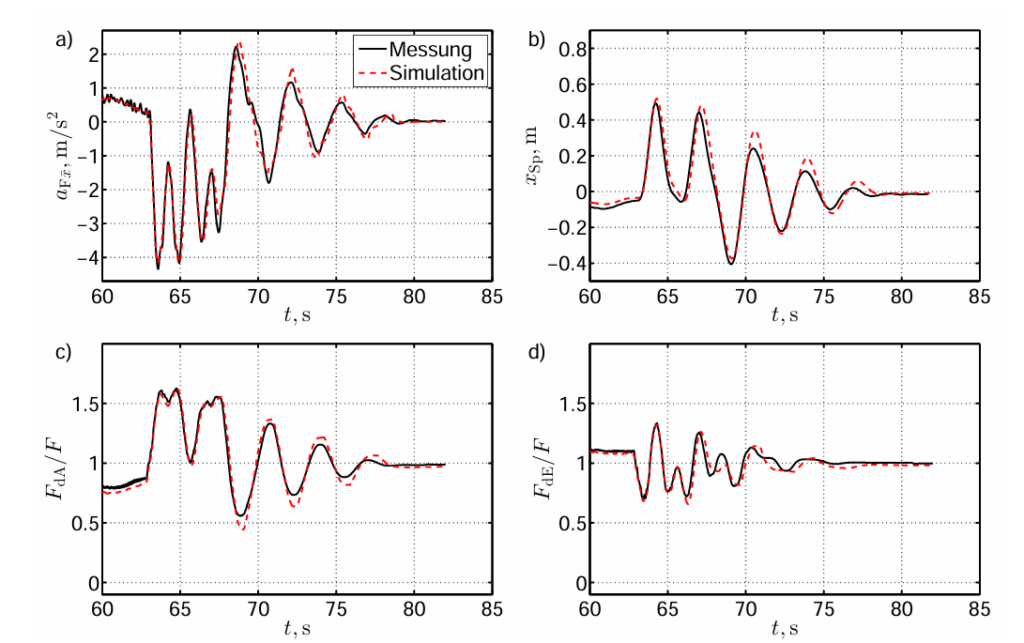
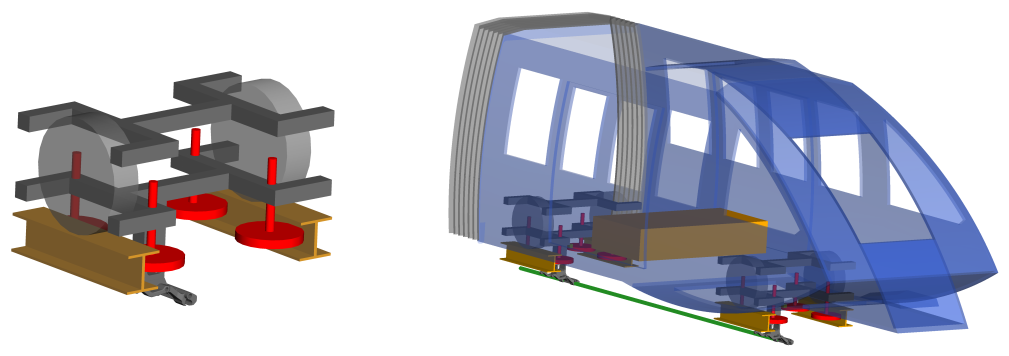
The theoretical foundation for Multibody Systems is based on three-dimensional rigid body dynamics. The core of its development involved ideally rigid bodies connected by ideal joints and force elements. Over the last decades, this methodology has undergone rapid development. An important step was the development of complex coupling elements, such as non-linear spring-damper elements (with amplitude and frequency dependency), air and leaf springs, and elements for modeling contact, friction, and hydrodynamic effects. Another important milestone was the integration of elastic bodies via Finite Element methods and their coupling with tools for damage calculation. This allows for accurate predictions regarding the fatigue life of virtually any mechanism without the need for physical prototypes.
Data analysis
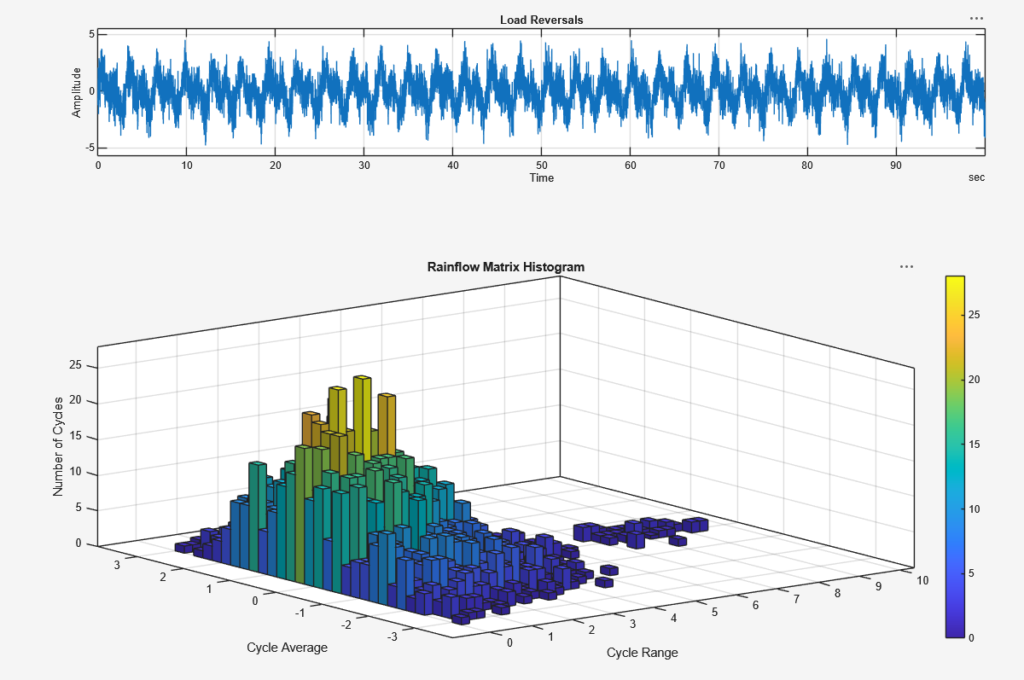
In addition to realistic modeling incorporating the relevant physical effects and using appropriate solver technology for the simulation, the third crucial step is to extract the relevant facts for subsequent design decisions from the resulting simulation data. To achieve this, we utilize the onboard post-processors of multibody tools as well as mathematical software, such as Matlab or GNU Octave, for in-depth analysis. These methods are inherently applicable to measurement data as well.